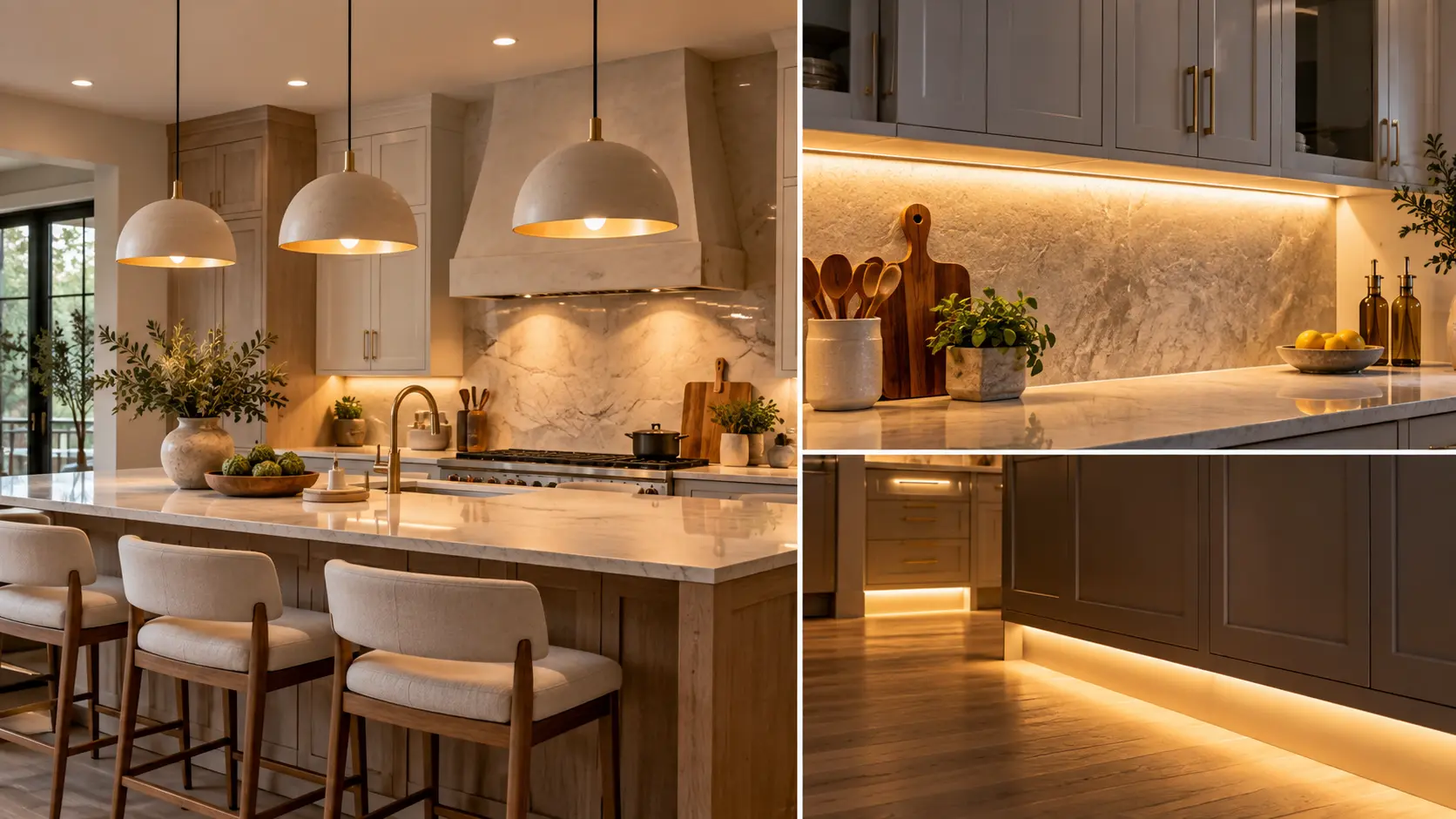
Good kitchen lighting does much more than make a room brighter. It helps you see clearly while chopping and cooking, makes countertops easier to use, highlights beautiful finishes, and creates a warmer atmosphere when the workday is over.
The best modern kitchens rarely rely on one ceiling fixture. Instead, they combine several types of light at different heights. This layered approach gives you practical task lighting where you need it while making the room feel comfortable and inviting.
If you are planning a remodel, updating an apartment, or simply looking for practical kitchen lighting ideas, these 15 options show where different lights work best and what each one can add to your space.
1. Start With Well-Placed Recessed Ceiling Lights
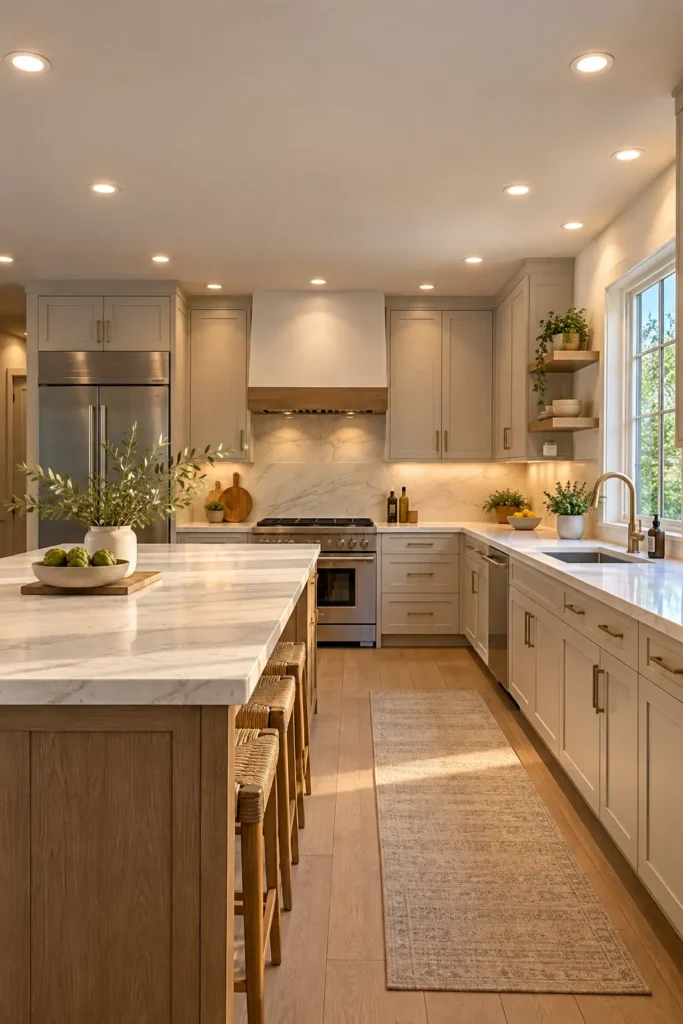
Recessed lights are a practical foundation for modern kitchen lighting because they provide even general illumination without visually cluttering the ceiling.
Placement matters more than the number of lights. Avoid arranging recessed lights in a simple grid without considering the countertops below. If the fixtures sit too far behind you, your body can cast a shadow over the exact surface where you are preparing food.
Instead, position ceiling lights so they illuminate work areas, walkways, and cabinet fronts without creating dark corners.
Best for: Almost every modern kitchen.
Design tip: Use recessed lighting as the background layer rather than expecting it to handle every lighting task on its own.
2. Add Under-Cabinet Lighting to Brighten Worktops
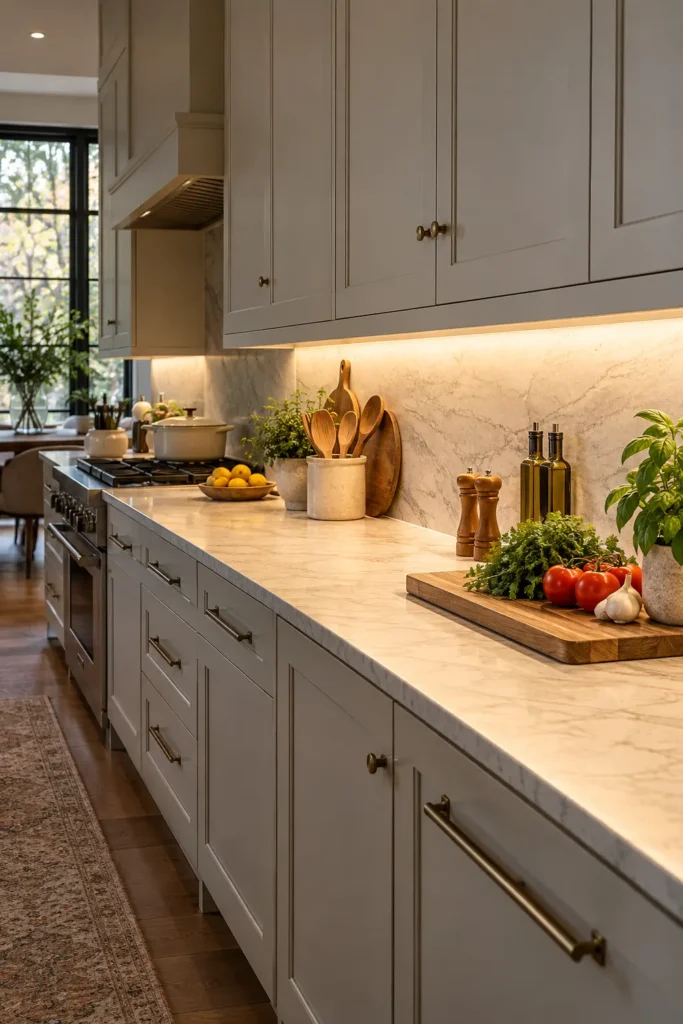
One of the most useful kitchen lighting ideas is also one of the least visually intrusive.
Install continuous LED lighting beneath upper cabinets to illuminate countertops directly. This makes chopping, measuring, cooking, and cleaning much easier, especially in kitchens where overhead lighting leaves shadows beneath cabinets.
Continuous LED strips usually create a cleaner and more even result than individual puck lights.
For the best coverage, position the strip closer to the front of the cabinet rather than pushing it all the way against the backsplash.
Best for: Kitchens with wall cabinets and darker countertop areas.
Design tip: Conceal the actual LED strip behind a small trim or diffuser so you see the glow rather than individual light dots.
3. Use Pendant Lights to Define the Kitchen Island
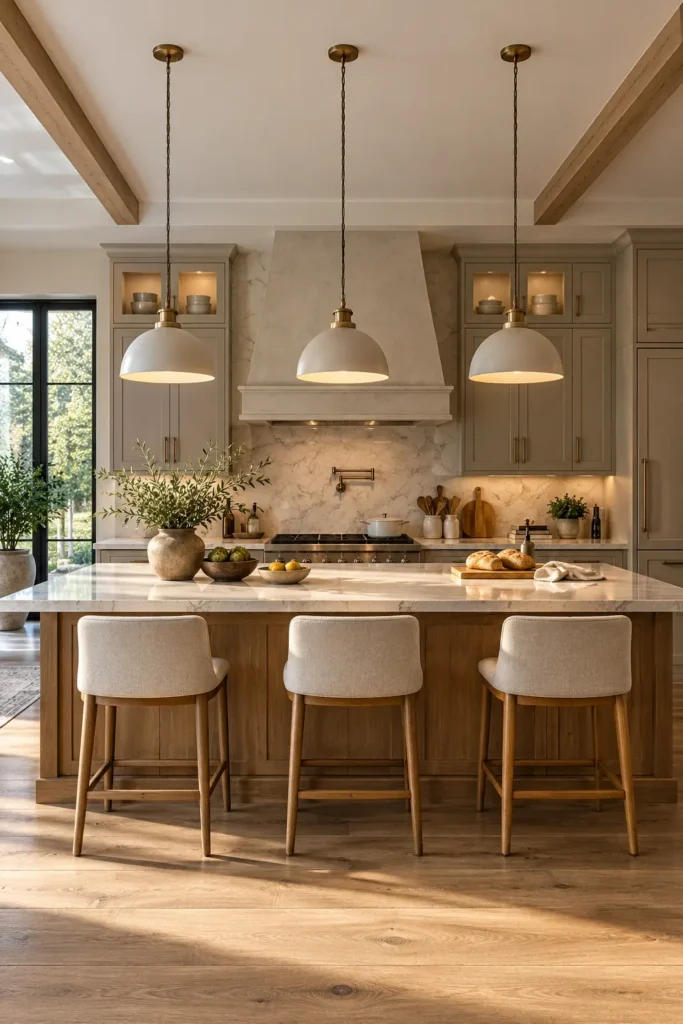
A kitchen island naturally becomes a focal point, so the lighting above it should feel intentional.
Two or three pendants can help visually anchor a long island while providing useful illumination for food preparation, homework, casual meals, and entertaining.
For a cleaner contemporary look, consider one long linear pendant instead of several individual fixtures.
Scale is important. Tiny pendants can look lost above a large island, while oversized fixtures may block sightlines across an open-plan room.
Best for: Kitchens with islands or large peninsulas.
Design tip: Choose pendants that complement the kitchen without becoming so decorative that they compete with every other feature.
4. Give the Sink Its Own Task Light
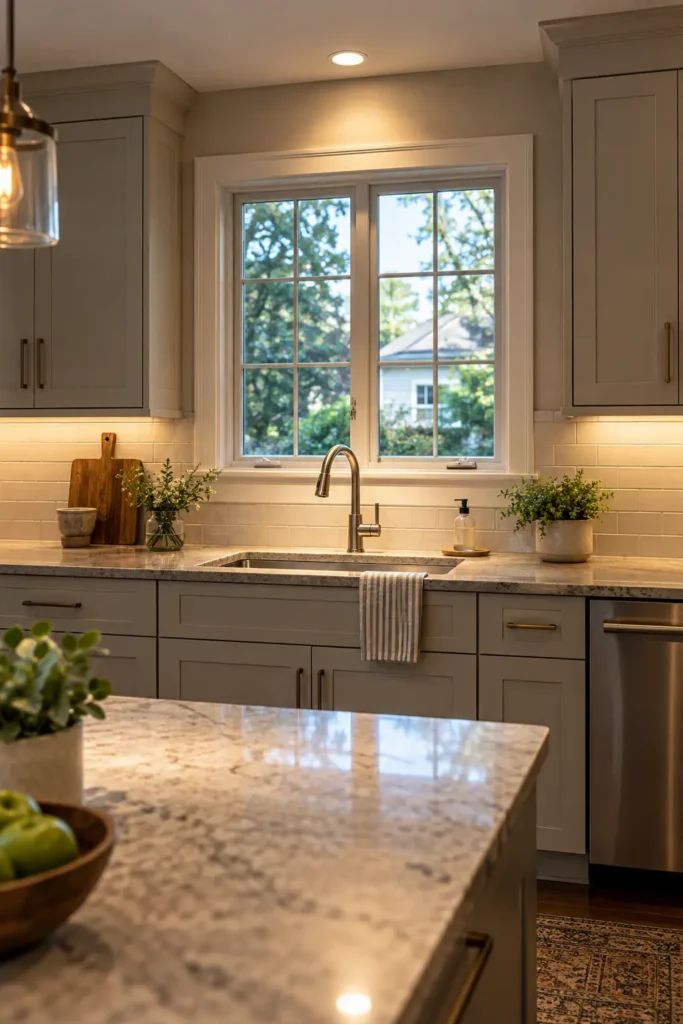
The sink is one of the busiest areas in any kitchen, yet it is often overlooked when lighting is planned.
A recessed ceiling light directly above the sink can make washing dishes, preparing vegetables, and cleaning much easier.
If the sink sits against a wall instead of beneath a window, a small wall-mounted sconce can provide both practical illumination and an attractive architectural detail.
Best for: Kitchens where the sink feels noticeably darker than surrounding counters.
Design tip: Keep the fixture simple if the kitchen already has statement pendants elsewhere.
5. Make Sure the Cooktop Is Properly Lit
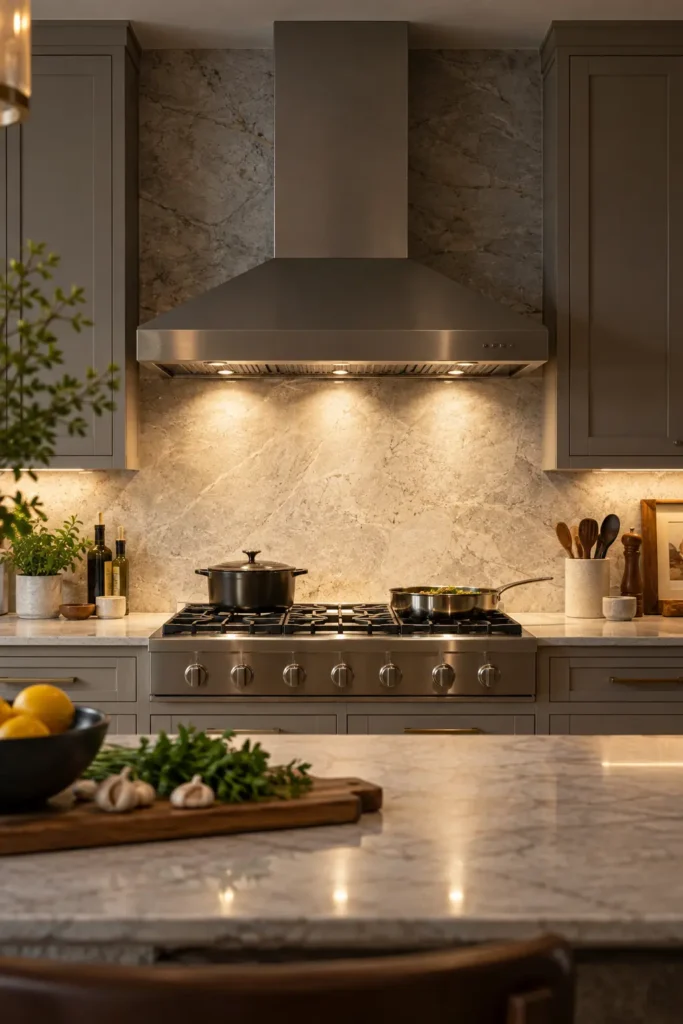
Good lighting over the stove is about function first.
Most modern range hoods include built-in task lighting that shines directly onto the cooktop. This focused light helps you monitor food more easily and keeps the cooking area safer and more comfortable to use.
If you are replacing a hood, do not focus only on its shape and finish. Pay attention to the quality and coverage of its integrated lights too.
Best for: Every kitchen with a dedicated cooktop or range.
Design tip: Coordinate the color temperature of the hood light with nearby kitchen lighting so the cooking area does not look noticeably cooler or warmer than the rest of the room.
6. Illuminate Open Shelves From Below
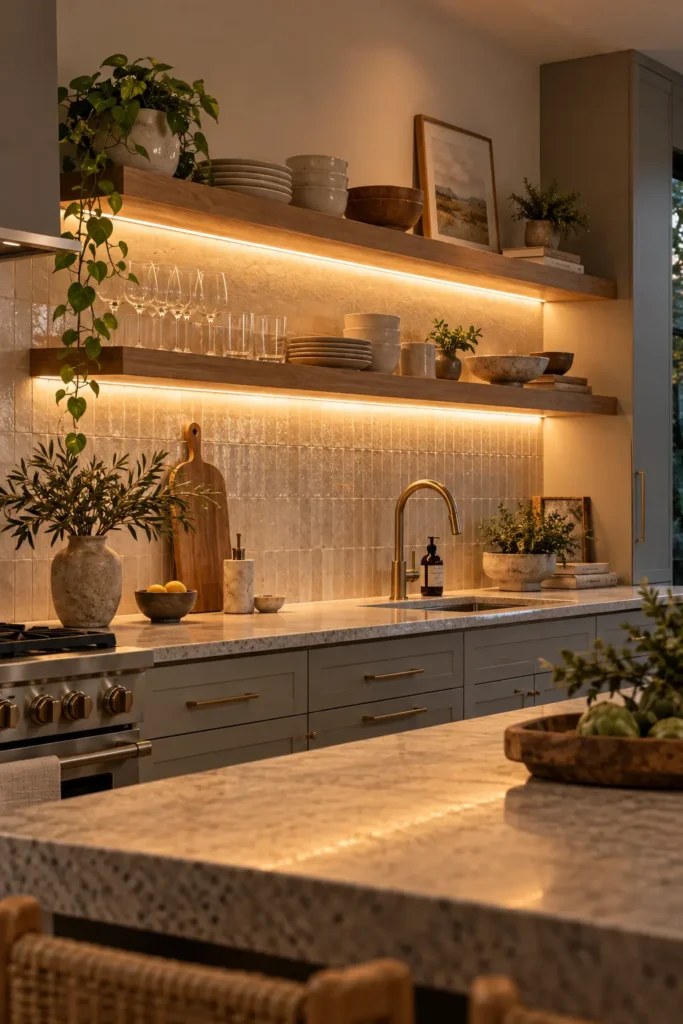
Open shelving can become more than storage when lighting is integrated into the design.
A concealed LED strip beneath a floating shelf softly illuminates the backsplash and countertop below while highlighting ceramics, glassware, or decorative objects displayed above.
The result is especially effective in the evening because it creates a softer alternative to bright overhead lights.
Best for: Contemporary kitchens with floating shelves instead of traditional upper cabinets.
Design tip: Keep shelf styling restrained. Lighting looks more sophisticated when it highlights a few carefully chosen objects rather than a crowded display.
7. Add Lighting Inside Glass-Front Cabinets
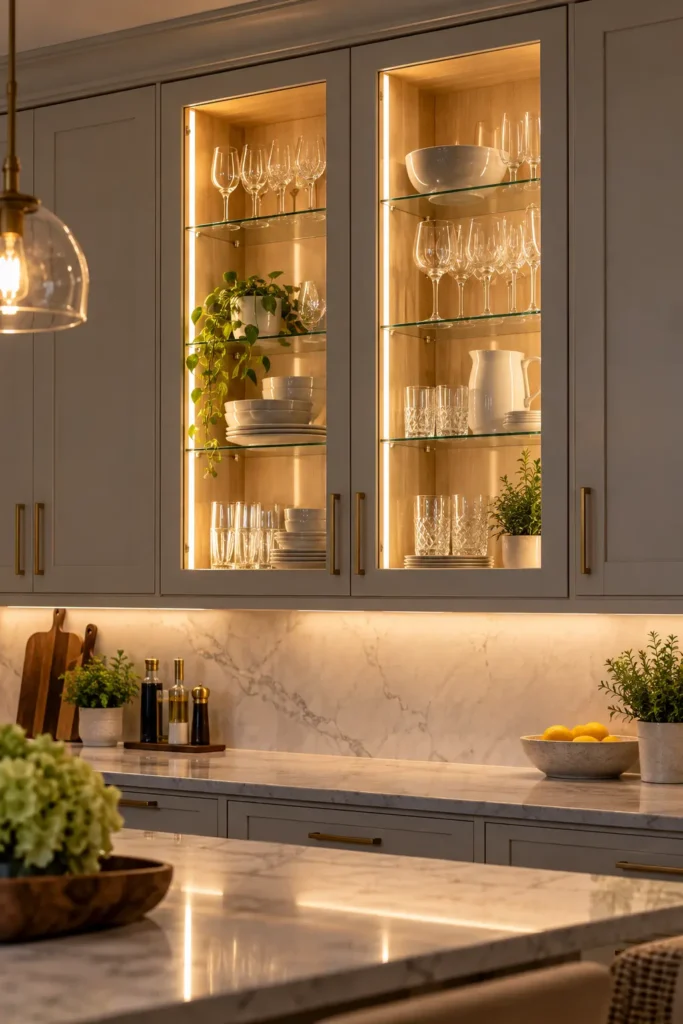
Glass cabinets are a natural place to introduce subtle accent lighting.
Small concealed LEDs can illuminate glassware, dishes, or decorative pieces from inside the cabinet, creating depth that ordinary ceiling lighting cannot achieve.
This works particularly well in kitchens where one or two glass-front cabinets are used as visual breaks between solid cabinetry.
Best for: Kitchens with display cabinets or a built-in hutch.
Design tip: Use interior lighting selectively. Lighting every cabinet can reduce the special effect.
8. Use Toe-Kick Lighting for a Soft Evening Glow
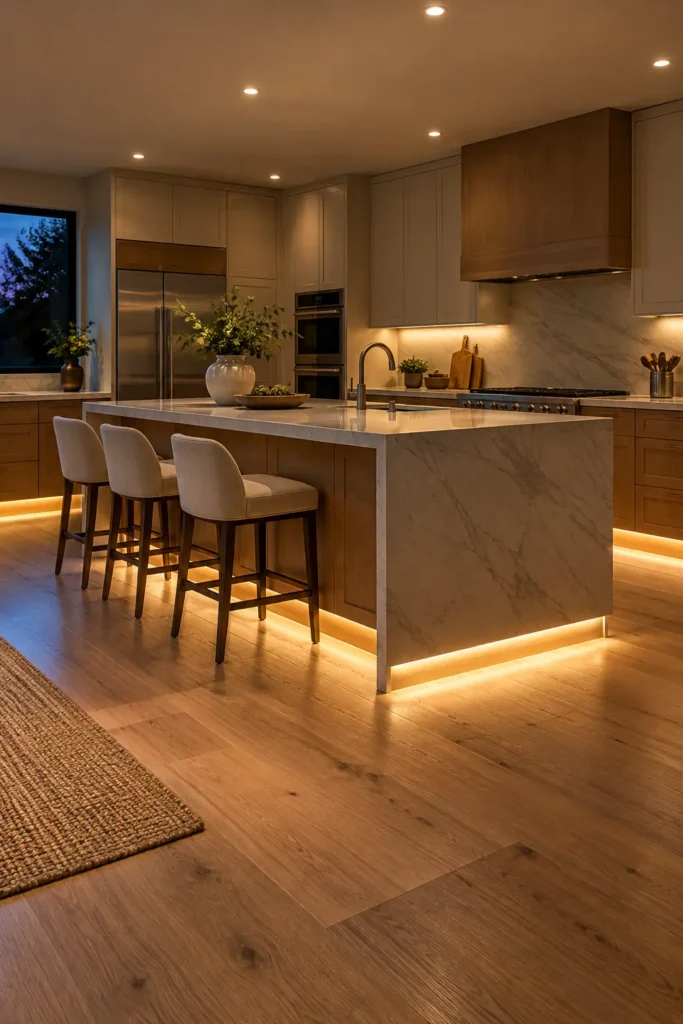
Lighting does not always need to come from above.
A concealed LED strip beneath base cabinets or an island can create a subtle glow across the floor. This makes heavy cabinetry appear slightly lighter and gives the kitchen a polished, contemporary look.
Toe-kick lighting is also useful at night when you want enough visibility to walk through the kitchen without switching on bright ceiling lights.
Best for: Modern kitchens, open-plan spaces, and homes where the kitchen is frequently used after dark.
Design tip: Keep this layer soft. Toe-kick lighting should create atmosphere, not become one of the brightest lights in the room.
9. Highlight a Beautiful Backsplash
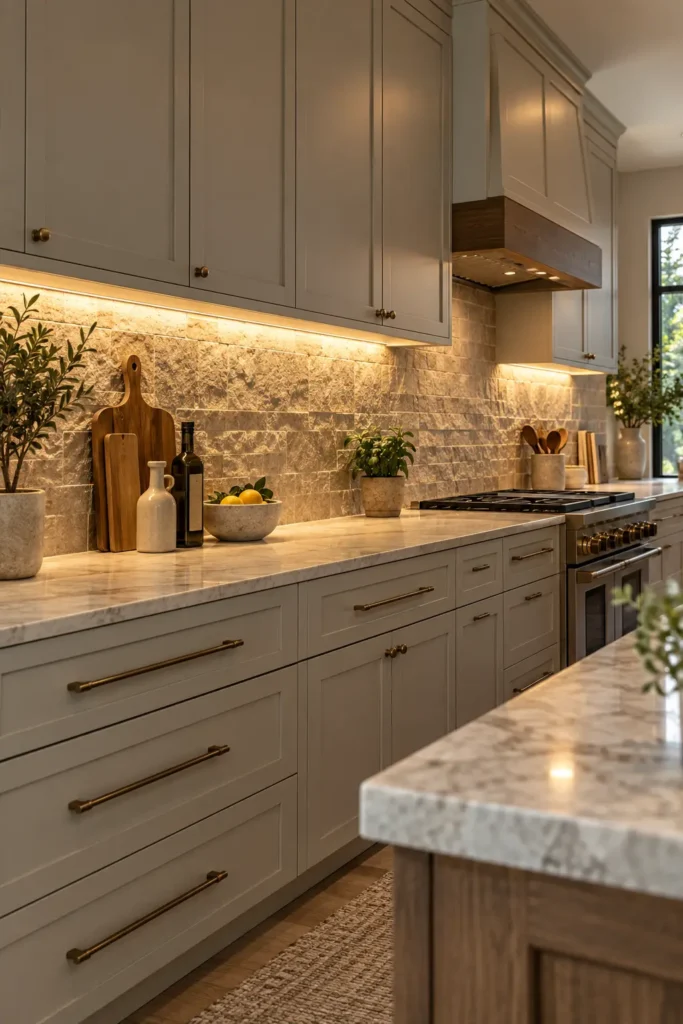
If your kitchen includes textured tile, natural stone, handmade ceramics, or another special backsplash, lighting can make the material much more noticeable.
Under-cabinet lights, small directional ceiling fixtures, or concealed lighting within a range niche can wash light gently across the surface.
The shadows created by textured materials add depth, particularly in kitchens with otherwise simple cabinetry.
Best for: Kitchens with a backsplash worth highlighting.
Design tip: Angle the light carefully. Highly polished materials may create distracting reflections if the light is too direct.
10. Light an Architectural Range Alcove
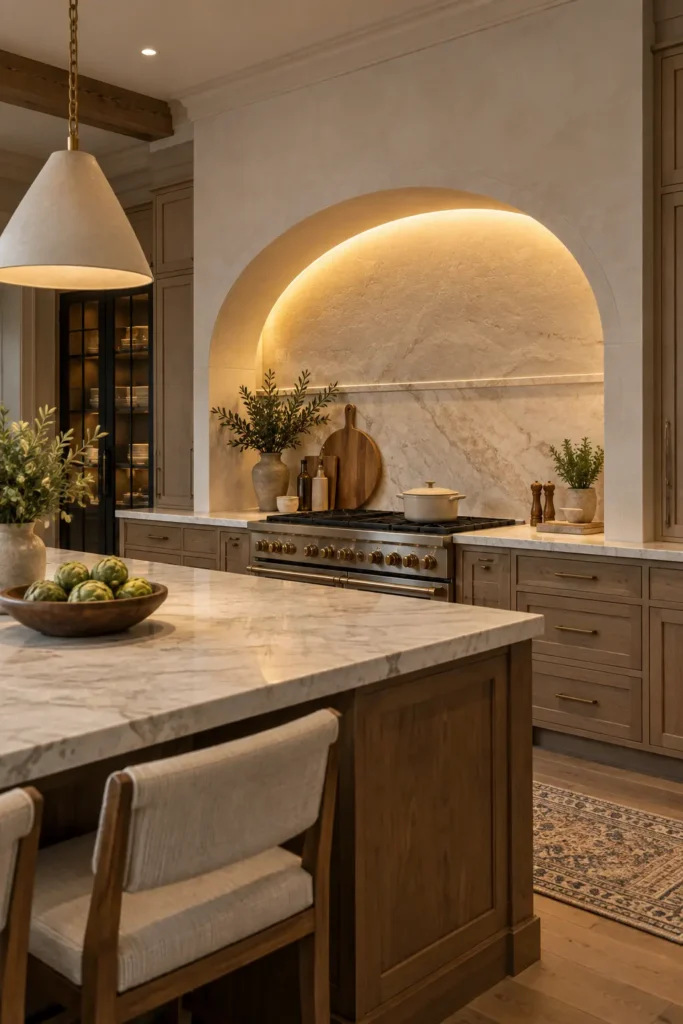
A range alcove or plaster hood can become a dramatic feature with discreet integrated lighting.
Instead of adding another visible fixture, conceal a warm light inside the niche or beneath the hood. The light draws attention to the cooking zone while emphasizing its shape and materials.
This technique works particularly well in modern transitional kitchens because it adds visual interest without introducing more decorative objects.
Best for: Kitchens with arched range niches, statement hoods, or recessed cooking areas.
Design tip: Keep the light source hidden whenever possible so the architecture, rather than the bulb, becomes the focal point.
11. Give the Breakfast Nook Separate Lighting
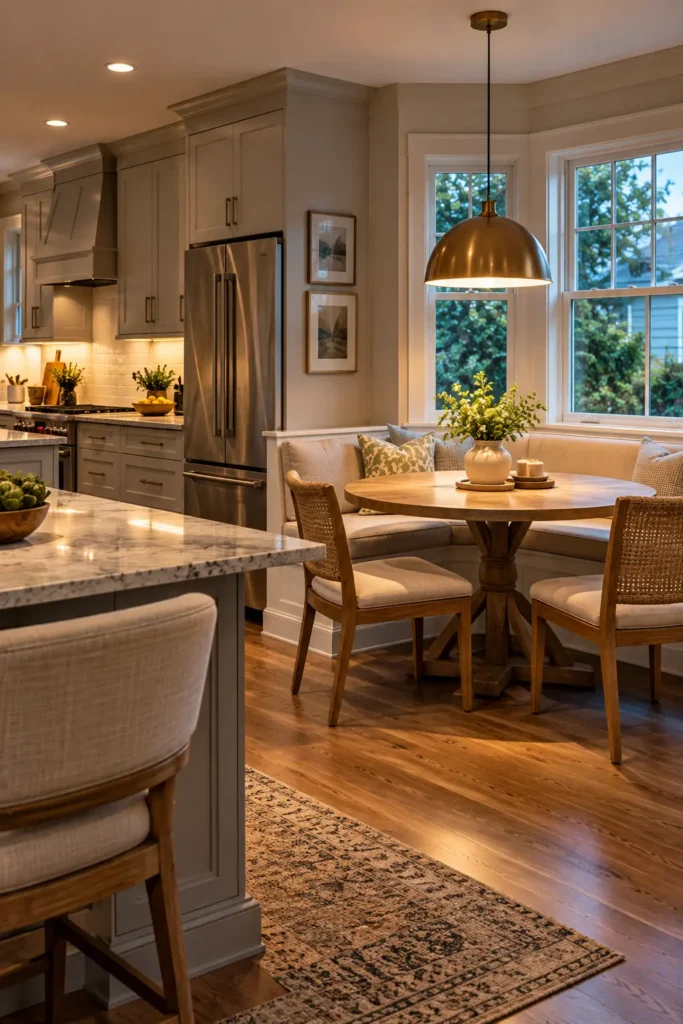
If your kitchen includes a breakfast table, banquette, or dining corner, treat it as its own zone.
A pendant or compact chandelier above the table visually separates the eating area from the cooking area while making the corner feel more intimate.
This is particularly useful in open-plan kitchens where several activities happen within one larger room.
Best for: Eat-in kitchens and spaces with built-in breakfast seating.
Design tip: Choose a fixture that relates to the kitchen lighting without matching it exactly. Coordinated fixtures usually feel more natural than identical ones.
12. Add Sensor Lighting Inside the Pantry
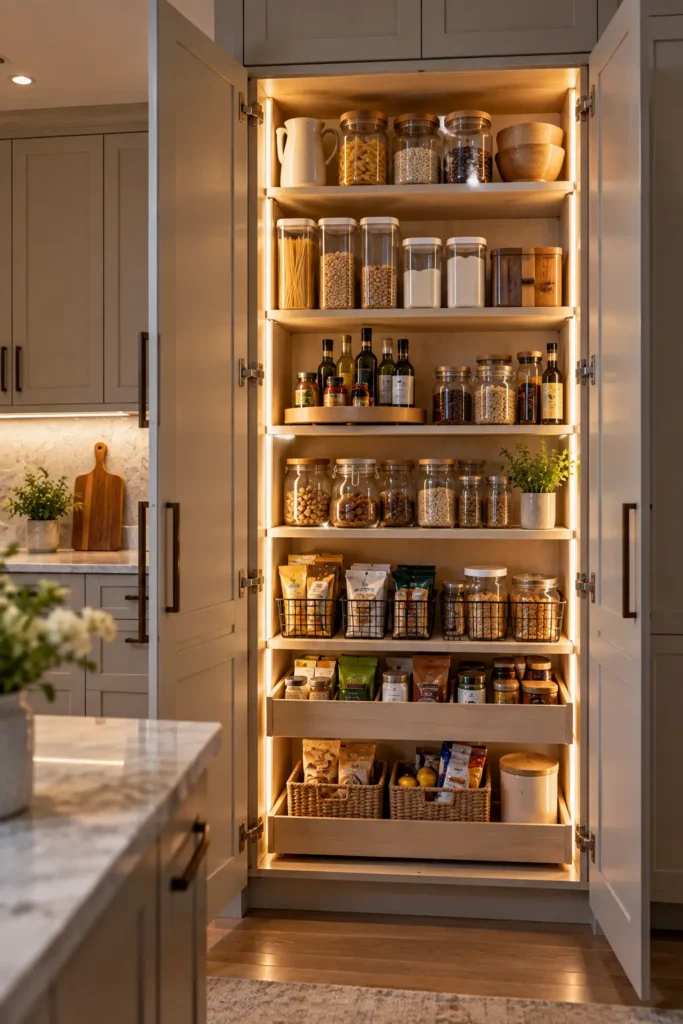
Pantry lighting is a small detail that can make a kitchen noticeably easier to use.
Motion-activated or door-activated LEDs automatically illuminate shelves when the pantry opens, making ingredients and small items easier to find.
The same idea can work inside deep storage cabinets where overhead kitchen lighting cannot reach.
Best for: Walk-in pantries, tall pantry cabinets, and deep kitchen storage.
Design tip: Position lights near the front or sides of shelving so items on higher shelves do not cast large shadows onto everything below.
13. Illuminate Deep Drawers and Cabinets
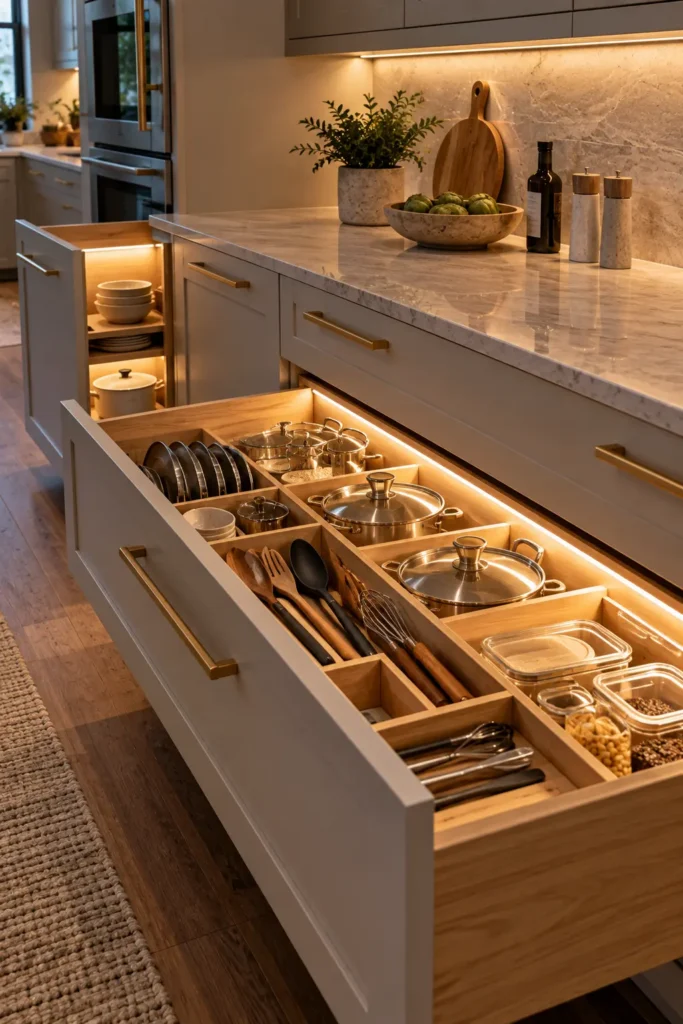
Interior cabinet lighting is especially useful in large modern kitchens where storage can be deep.
Small sensor-operated LEDs inside drawers or cabinets make cookware, utensils, and pantry items easier to see without adding permanent brightness to the room.
Although this lighting is mostly functional, it also gives custom cabinetry a more refined feel.
Best for: Deep drawers, corner cabinets, appliance garages, and tall storage units.
Design tip: Reserve interior lighting for storage areas where it solves a genuine visibility problem.
14. Use Indirect Lighting Above Cabinets
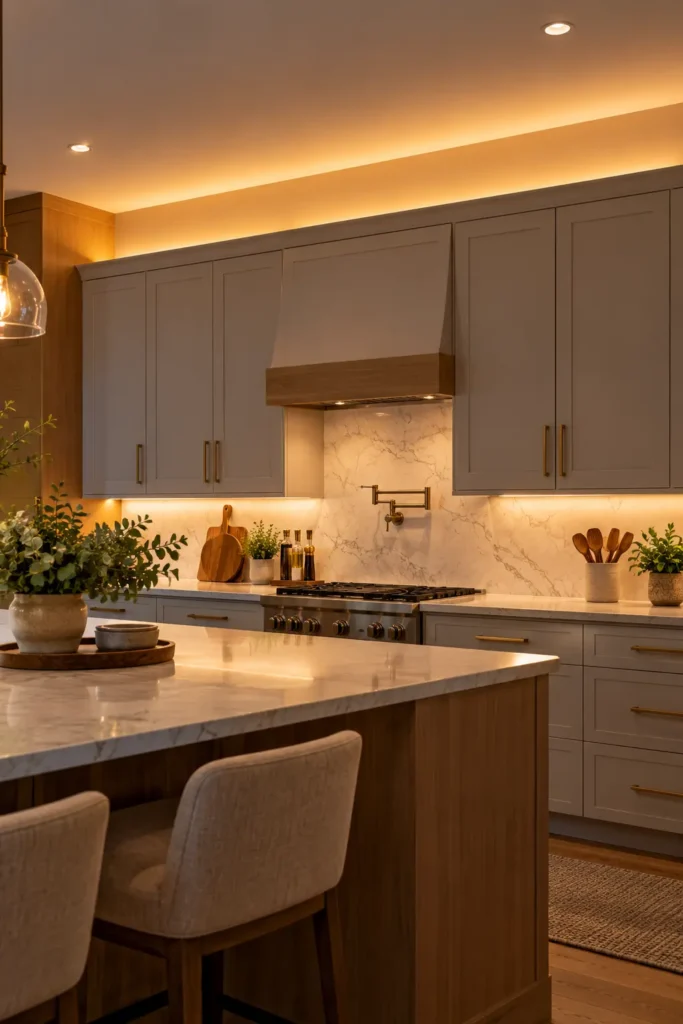
If your cabinets stop below the ceiling, the space above them can sometimes feel dark.
A concealed LED strip placed above the cabinetry can wash soft light across the ceiling and create gentle indirect illumination.
Because you do not see the light source directly, the effect feels softer than another row of ceiling fixtures.
This works particularly well in the evening when you want the kitchen to feel inviting rather than fully illuminated for cooking.
Best for: Kitchens with a visible gap between upper cabinets and the ceiling.
Design tip: Keep the upper area uncluttered. Indirect lighting looks cleaner when it is not illuminating a collection of decorative objects.
15. Put Different Kitchen Lights on Separate Controls
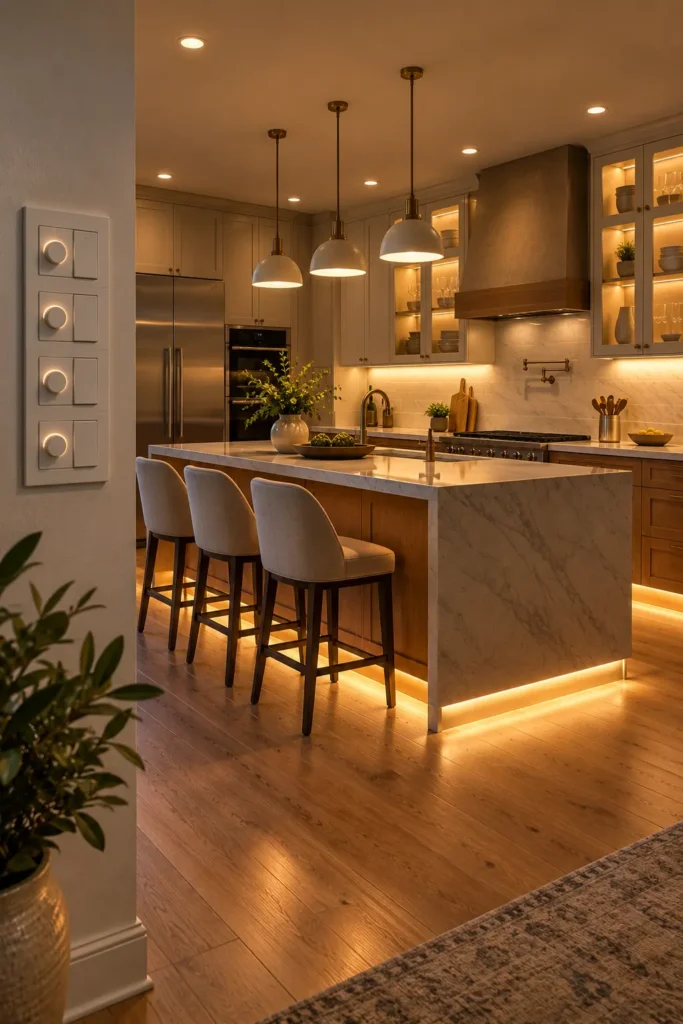
One of the biggest improvements you can make to kitchen lighting does not involve buying another decorative fixture.
Put different lighting layers on separate switches or dimmers.
For example, recessed ceiling lights, pendants, under-cabinet LEDs, accent lights, and toe-kick lighting can each operate independently.
During food preparation, you may want ceiling and task lighting at full brightness. During dinner, you might prefer pendants and under-cabinet lights. Late at night, a soft toe-kick or shelf light may be all you need.
Separate controls allow one kitchen to adapt to all of these situations.
Best for: Any kitchen renovation or new lighting installation.
Design tip: Plan the lighting zones before electrical work begins. It is much easier than trying to separate circuits after the kitchen is finished.
How to Layer Kitchen Lighting
The easiest way to understand kitchen lighting is to think in three layers.
Ambient lighting gives the room its overall brightness. Recessed lights and ceiling fixtures usually handle this job.
Task lighting illuminates the places where you actually work. Under-cabinet LEDs, sink lights, and range-hood lighting are good examples.
Accent lighting adds depth and atmosphere. Glass-cabinet lights, shelf lighting, architectural illumination, and toe-kick LEDs fall into this category.
A well-designed modern kitchen usually combines all three rather than relying on a single type of fixture.
What Color Temperature Works Best in a Kitchen?
For many homes, warm to neutral-white lighting creates the most comfortable balance.
Very cool light can make a residential kitchen feel clinical, while extremely warm light may make detailed food preparation harder.
The most important point is consistency. Fixtures positioned close to one another should generally have similar-looking light so the room feels unified instead of patchy.
Dimmable lighting gives you even more flexibility, allowing brighter task lighting during the day and a softer atmosphere in the evening.
A Brighter Kitchen Starts With Better Lighting
The best kitchen lighting ideas are not simply about choosing an attractive pendant. A comfortable kitchen needs light in the places where everyday activities actually happen.
Start with good general ceiling lighting, then brighten countertops, the sink, and the cooktop with dedicated task lights. After the practical areas are covered, use pendants, cabinet lighting, illuminated shelves, architectural accents, or toe-kick LEDs to give the room warmth and personality.
When these layers are controlled separately, the same kitchen can feel bright and functional while you are cooking and calm and inviting when the work is finished.
That combination of ambient, task, and accent lighting is what makes a modern kitchen both beautiful and genuinely enjoyable to use.